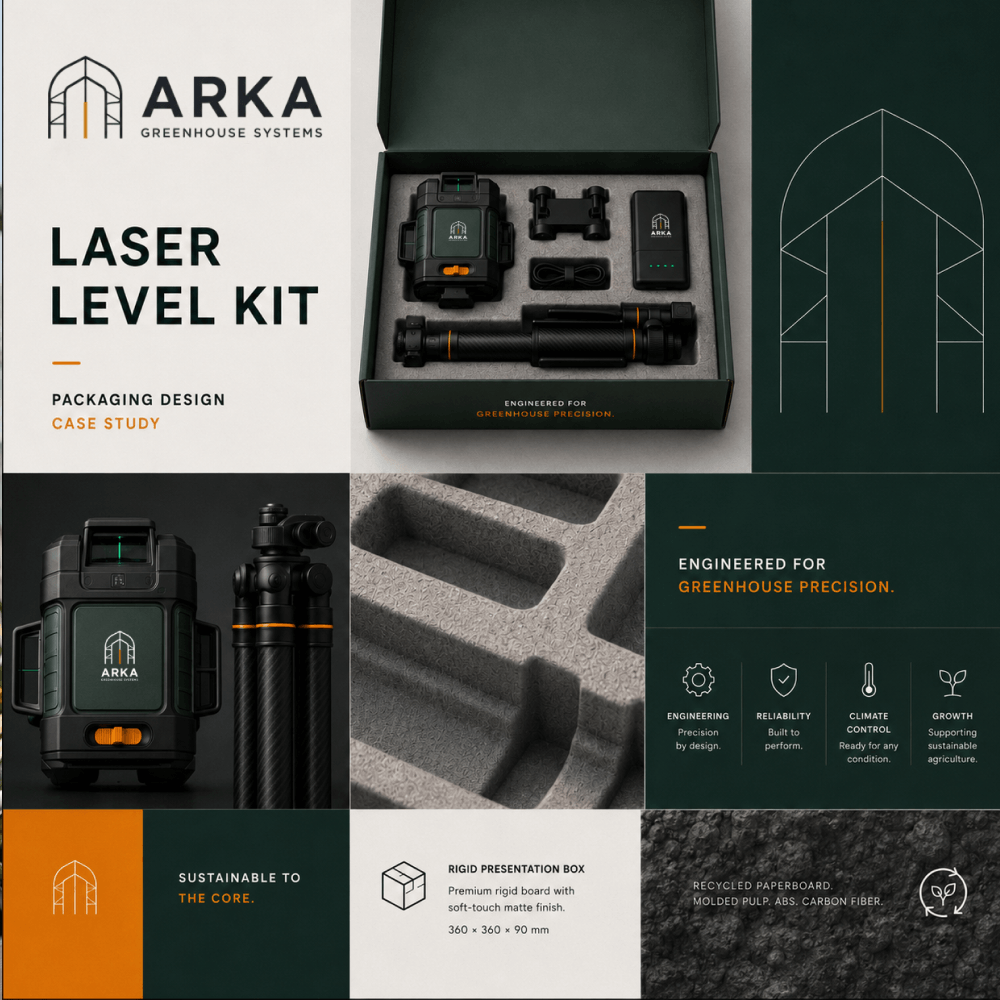
The box serves three purposes at once: protecting the contents, unifying the items, and creating the first impression. The fitted insert holds products in the correct position and helps control the opening sequence. If these components are calculated separately from the contents, gaps, pressure on fragile parts, and excess volume result.
The choice starts with the exact items and delivery method.
Main box constructions
| Construction | Advantage | Limitation | Suitable use case |
|---|---|---|---|
| Lid-and-base box | Simple and straightforward | Additional securing is needed | Sweets, mugs, basic sets |
| Book-style box | An impressive opening experience | More complex construction and assembly | Partners, welcome kits, premium gifts |
| Drawer box | Compactness and opening sequence | The sliding section requires precise calculation | Planners and small sets |
| Magnetic-closure box | A premium feel | Weight and cost | VIP gifts, textiles, large sets |
| Self-assembly box | Flat storage | Visible folds and manual assembly | Large runs, events, delivery |
| Wooden box | Strength and reuse | Weight and cost | Awards, collectible gifts |
Ready-made or custom box
A ready-made box reduces the lead time and lets you see the material in advance. It works if the contents can be adapted to an existing size. For example, My Warm Box is designed for large sets, Doc has a specific layout for a stationery and tech set, while Slender is suitable for small, flat items.
A custom construction is needed when precise shape, unusual mechanics, a large series, or a special opening sequence matters.
How the internal dimensions are calculated
The product’s nominal dimensions are not enough. Consider:
- protruding lids and handles;
- each item’s individual packaging;
- the fitted insert material’s thickness;
- a production clearance;
- space for finger access;
- possible product substitutions;
- deformation of the textiles;
- the outer shipping box.
A protective zone is added for fragile items. Textile dimensions are checked as the item will actually be folded.
Types of fitted inserts
EVA and foam materials
They hold metal items, electronics, glass, and collectibles securely. They allow a precise outline to be made. For a premium appearance, the surface can be covered with fabric, paper, or flock.
Limitation: precision die cutting leaves little flexibility for replacing the product model.
Cardboard fitted insert
Suitable for mugs, jars, stationery, and large-volume sets. The construction may consist of compartments, a platform, or a folded insert.
An example of a separate component is a cardboard fitted insert for a decanter and glasses. It shows how the upper and lower parts work together to hold the items.
Molded pulp
Suitable for recurring projects and complex shapes. It looks technical and supports an eco concept, but requires dedicated tooling and a production run.
Paper filler
It is convenient for changing contents and textiles. It creates volume but does not secure heavy or fragile items.
Tissue paper and wrapping
They act as a visual and protective layer. Tissue paper does not replace structural restraints, but helps conceal the contents and create an opening sequence.
How to choose a fitted insert for the item
| Item | Recommended securing method | What to check |
|---|---|---|
| Mug or jar | Cardboard compartment or EVA | Handle, lid, lateral movement |
| Power bank | EVA or a cardboard platform | Cable, buttons, removal |
| Blanket | Strap, sleeve, tissue paper | Volume and shape retention |
| Planner | Platform, drawer box, sleeve | Block thickness and corners |
| Christmas tree ornament | Individual compartment | Fragility and movement |
| A set of jars | Dividers and top restraints | Weight, glass, upright positioning |
Opening sequence
The fitted insert can guide attention. The main item is placed first or in the center, with additional details revealed later. Convenience must not be sacrificed for a photograph. The recipient should understand how to remove the products effortlessly.
Place printed materials so they do not fall out or cover the items. The card can be secured inside the lid, placed on tissue paper, or given a separate pocket.
Transport test
The gift box is placed in outer shipping packaging and tested on the actual route:
- Close the complete set.
- Pack it in an outer box.
- Secure any gaps.
- Test carrying and a short transport journey.
- Check for item movement.
- Assess the corners and surface.
- Reopen the gift as the recipient would.
Testing for delivery to individual addresses should be stricter than for handover in the office.
When a box can be reusable
Reusable packaging makes sense when it has a clear function after handover: storing documents, accessories, tea, or keepsakes. Simply writing “reuse” is not enough.
FAQ
Can one box be used for several sets of contents?
Yes, if a universal divider or modular fitted insert is provided. Precision die cutting for one SKU limits substitutions.
Which costs less: EVA or cardboard?
The cost depends on thickness, shape, quantity, and finishing. Cardboard often suits large-volume projects, while EVA secures heavy items better.
Is a physical prototype needed?
Yes, if the box is custom-made or contains fragile items.
Can a box be calculated from catalog dimensions?
For a preliminary estimate, yes, but use physical samples or accurate drawings before production.
How should the card be secured?
In a lid pocket, under a ribbon, on tissue paper, or in a separate slot.
Does the fitted insert need branding?
Not necessarily. Color, material, and a neat shape already support the design.
How can the box volume be reduced?
Change the layout, remove unnecessary items, or use a multilevel construction. No pressure should be applied to the products.
| Impulse Media can review the contents, create the layout, develop the box and fitted insert, make a prototype, and organize production. |
|---|