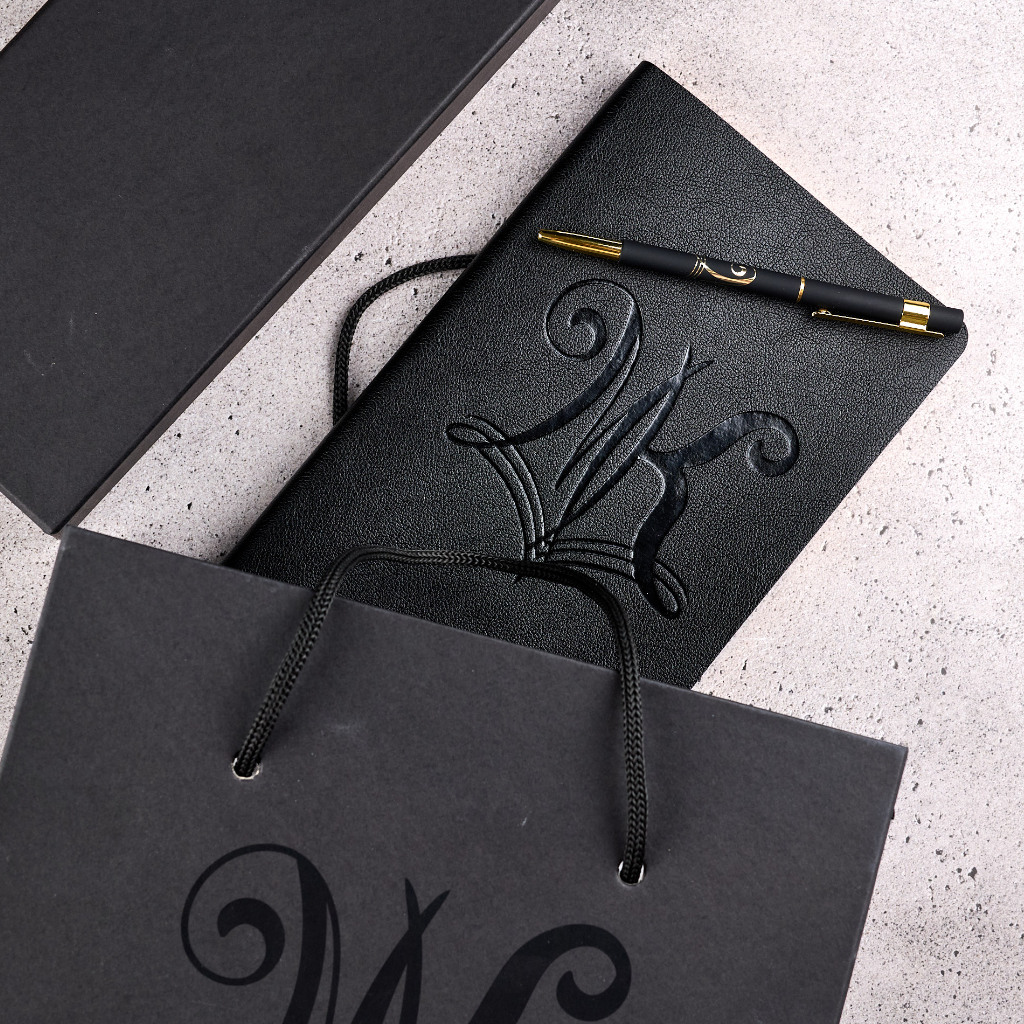
Packaging should do more than look expensive. It must protect the products, support assembly, withstand shipping, and provide the right opening sequence. A tote bag or folder may be enough for a small welcome pack, while a fragile premium set needs a rigid box with a fitted insert.
Below, we examine constructions, materials, the production sequence, and ready-made catalog boxes for different handover and delivery scenarios.
| Prices and stock levels are stated as of July 24, 2026. Confirm current details with a manager before ordering. |
|---|
First Define How the Packaging Will Be Used
The same box does not suit every task. Before choosing a construction, determine:
- whether the gift will be handed over in person or sent by courier;
- how many items the set contains;
- whether there is glass, ceramic, or electronics;
- whether the box needs to be kept after opening;
- whether the unboxing sequence matters;
- whether the set will be personalized;
- how the boxes are transported and stored;
- who assembles the sets and where.
When a gift is handed out at a large event, speed and compactness matter more than a complex mechanism. If the set is sent to an executive, the packaging becomes part of the gift itself.
Main Constructions
| Construction | Advantage | Limitation | Suitable use case |
|---|---|---|---|
| Lid-and-base box | Simple, Straightforward, Easy to Scale | The Lid May Come Off During Transport If It Is Not Secured | Sweets, a Mug, Basic Sets |
| Book-style box | Impressive Opening, Large Design Area | Requires Precise Flap and Magnet Design | Partners, welcome kits, premium gifts |
| Drawer box | Sequential Unboxing, Compact Shape | The Sliding Element Must Move Without Jamming | Stationery, Small Sets |
| Collapsible Magnetic | Saves Storage and Shipping Space | Fold Lines Are Visible; Careful Assembly Is Required | Medium Run, Regional Delivery |
| Paper-Covered Rigid Box | High Rigidity and a Premium Feel | Cost, Storage Space, Longer Lead Time | VIP, New Year, Awards |
| Wooden box | Durability and Value in Its Own Right | Weight, Price, Logistics Constraints | Anniversary, Collectible Gift |
| Tote Bag or Reusable Pouch | The Packaging Remains a Useful Item | Offers Less Protection for Fragile Products | Welcome Pack, Event Kit, Textiles |
Ready-Made Box or Custom Construction
A ready-made model helps you assemble the project faster and inspect the material and opening mechanism in advance. It works if the products can be adapted to the existing size. A custom box is designed around the exact contents and gives better control over the layout, but requires time for drawings, prototyping, and production.
The Correct Sequence for a Custom Project:
- Approve the Exact Products and Variants.
- Obtain physical samples.
- Define the layout and opening sequence.
- Calculate the internal dimensions.
- Choose the materials for the box and insert.
- Prepare a structural prototype.
- Approve the printing and finishing.
- Produce a preproduction sample.
- Carry out a transport test.
- Start the production run and assembly.
Designing a box from links or approximate dimensions is risky. Even a different lid on a travel mug may require a change in height.
Six Ready-Made Solutions from the Catalog
Raven XL: An Affordable Box for Medium and Large Items
Raven XL box cost around ₽249, with approximately 825 units in stock. This is a budget option for projects that need ready-made rigid packaging without developing a custom construction.
The model can be used for textiles, a small set, or a single standout item. Before ordering, check the internal dimensions, color, and how the contents are secured.
Recommended use case: a basic welcome pack, T-shirt, or compact employee set.
Color it M: A Ready-Made Box with Bold Design Options
Color it M cost around ₽541 and had good stock availability. The format suits a medium-sized corporate gift set. The model name suggests the potential for a bold color scheme, but the actual print area and finishing options need to be confirmed.
The box can be used with paper filler, a cardboard divider, or a simple fitted insert. For a large-scale project, check how long assembly takes.
Recommended use case: a set with a planner, pen, mug, and small accessory.
Modum ver.2: A Rigid Magnetic Box
Modum ver.2 cost around ₽660, with more than 2,500 units in stock. A rigid box with a magnetic closure feels more premium and suits gifts for partners.
Foil stamping and screen printing are available for decoration. It is better to use one expressive accent than overload the lid with a large print. Tissue paper, a card, ribbon, or an insert can be added inside.
Recommended use case: a business set, client gift, or executive welcome pack.
Collapsible Magnetic Box: Convenient Storage
Collapsible Magnetic Box cost around ₽847, with more than 2,600 units in stock. The main advantage is flat storage until assembly. This matters when boxes need to be delivered to a regional location or assembled directly at the packing warehouse.
Before the production run, check how quickly the box can be assembled, whether the magnets hold, and whether unwanted creases are visible on the outer surface.
Recommended use case: distributed assembly, regional projects, and midrange and premium sets.
Designer Box: For a Small Premium Run
Designer Box cost about 1 062 ₽. Stock was low on the date of the check. Digital printing, a metal sticker, or a nameplate can be used, making the model suitable for a more personalized design.
Because stock is limited, it is best used as a reference or for an individual gift. For a large project, find an alternative in advance or have the box custom-made.
Recommended use case: an executive gift, limited edition, or award.
Legno: A Wooden Box as Part of the Gift
Legno wooden box cost around ₽1,123, with approximately 30 units in stock. Wood creates a different feel from paper-covered board: the box can be used after the gift is presented and becomes an item in its own right.
Engraving, a nameplate, printing, or a combination of finishes works for wood. Account for weight and surface protection during transport.
Recommended use case: an anniversary, VIP gift, collectible award, or small run for partners.
How to Calculate the Internal Dimensions
The internal dimensions are not simply the sum of the products' nominal dimensions. Add production clearances, the insert thickness, space for removing the items, and an allowance for the actual samples.
For each item, record:
- the maximum length, width, and height;
- protruding lids, handles, and carabiners;
- placement orientation;
- fragile areas;
- the removal method;
- potential replacement with another model.
If the contents change frequently, use a universal divider, paper filler, or modular insert instead of cutting an exact shape for every SKU.
Types of fitted inserts
EVA and foam materials
They securely hold heavy, metal, and fragile items. They allow an exact outline to be cut. They may look overly technical if they are not covered with fabric, paper, or a decorative layer.
Cardboard fitted insert
Easier to recycle and suitable for stationery, mugs, and small sets. The construction must support the weight and resist crushing during transport.
Molded pulp
Suitable for series-produced eco projects and complex shapes, but requires a separate production process and run. The appearance is more industrial and honest.
Paper Filler and Tissue Paper
They are versatile and convenient for changing contents. They do not secure a heavy item as reliably, but make it easy to assemble different versions quickly.
Fabric Bag or Reusable Pouch
It can serve as both an insert and an additional gift. Especially suitable for textiles, travel sets, and wellness sets.
Box Materials
A rigid paper-covered box uses bookbinding board and an outer paper wrap. The board thickness is selected according to size and weight. The outer material can be coated, specialty, textured, or dyed-through paper.
Important Checks:
- the paper's abrasion resistance;
- crease visibility;
- the quality of the paper covering at the corners;
- color consistency across the batch;
- compatibility with embossing and printing;
- fingerprints on a dark matte surface.
Printing and finishing
- Offset or digital printing suits colors, illustrations, and patterns.
- Screen printing produces dense color on specialty paper.
- Foil stamping creates a metallic accent.
- Blind embossing creates relief without adding color.
- Embossing enhances the raised effect of an element.
- Spot UV varnish creates a contrast between matte and glossy areas.
- A nameplate adds a separate metal or plastic element.
- A packaging sleeve lets you change the occasion or name without producing a new run of the main box.
There is no need to combine every method at once. One main effect and one additional effect are usually enough.
How to Design the Unboxing Sequence
Unboxing is a sequence of actions, rather than just an attractive photo of an open box. The recipient first sees the outer surface, then opens the lid, reads the message, removes the tissue paper, and only then interacts with the products.
A Good Sequence:
- A short, clear message on the outside.
- A personalized card immediately upon opening.
- Place the main item at the visual center.
- Arrange additional items in a logical order.
- Instructions, a story, or a QR code without clutter.
- Easy removal of each product.
If an item is difficult to remove, the premium impression quickly disappears.
When a Box Is Not Needed
A box can be omitted if:
- the sets are handed out in large numbers and quickly;
- the set contains no fragile products;
- the tote bag or backpack is already part of the gift;
- the gift is sent in standard shipping packaging;
- the budget is better spent on the quality of the main item;
- the recipient has nowhere to store a bulky box.
In these cases, a reusable pouch, stand-up pouch, sleeve, folder, tote bag, or fabric bag works well.
Transport Packaging
A gift box is not always a shipping box. Magnets, corners, and specialty paper can be damaged without an outer carton. For shipping, calculate:
- an outer protective box;
- cushioning material;
- empty spaces;
- fragile labeling;
- moisture protection;
- palletization;
- the maximum weight of one shipping unit.
For direct shipping, the recipient label and the ability to quickly match each personalized set to its shipping box are also important.
Common mistakes
- Designing the packaging before the products are approved.
- Using external dimensions instead of internal dimensions.
- Making the insert fit too tightly.
- Failing to account for the mug handle, bottle cap, or cable.
- Choosing dark matte paper without testing for fingerprints.
- Making an expensive box for an underwhelming selection of contents.
- Failing to test drops and transportation.
- Adding too many finishing effects.
- Failing to consider assembly speed.
- Printing the date or occasion across the entire box, making leftover stock unusable for another project.
FAQ
Which Box Is Best for a Corporate Gift Set?
A rigid book-style box or lid-and-base box suits most sets. The choice depends on weight, size, the handover method, and the budget. A tote bag or folder may be more convenient for mass distribution.
When Is a Fitted Insert Needed?
When fragile, expensive, or heavy items need to be secured and presented in a precise arrangement. Tissue paper or filler can be used for textiles and changing contents.
What Is the Minimum Order for a Custom Box?
It depends on the construction, material, and printing. Paper-covered boxes usually require a larger run than branding ready-made stock models. The exact minimum quantity is determined after the drawing is completed.
Can Individual Names Be Added?
Yes. The name can be placed on a sleeve, card, nameplate, sticker, or the box itself. A replaceable element is more convenient when the main packaging is produced in a single run.
Which Is Cheaper: A Ready-Made Box or Custom Production?
For a small run, a ready-made model is usually more economical and faster. A custom construction makes sense when the contents are unusual, the unboxing experience matters, or a large repeatable run is needed.
How Do You Test Packaging Before Production?
Make a plain white structural prototype, then a preproduction sample with the actual products, and test assembly and transportation.
Can the Box Be Reused?
Yes, if the construction is sturdy, the insert is not overly specific, and the exterior design is not tied to a single date. It is best to design for reuse from the outset.
Discuss your project
Send Impulse Media the product list, physical dimensions, quantity, date, and delivery method. We will suggest ready-made boxes or develop a custom construction, select the insert, and prepare a visualization and preproduction sample.