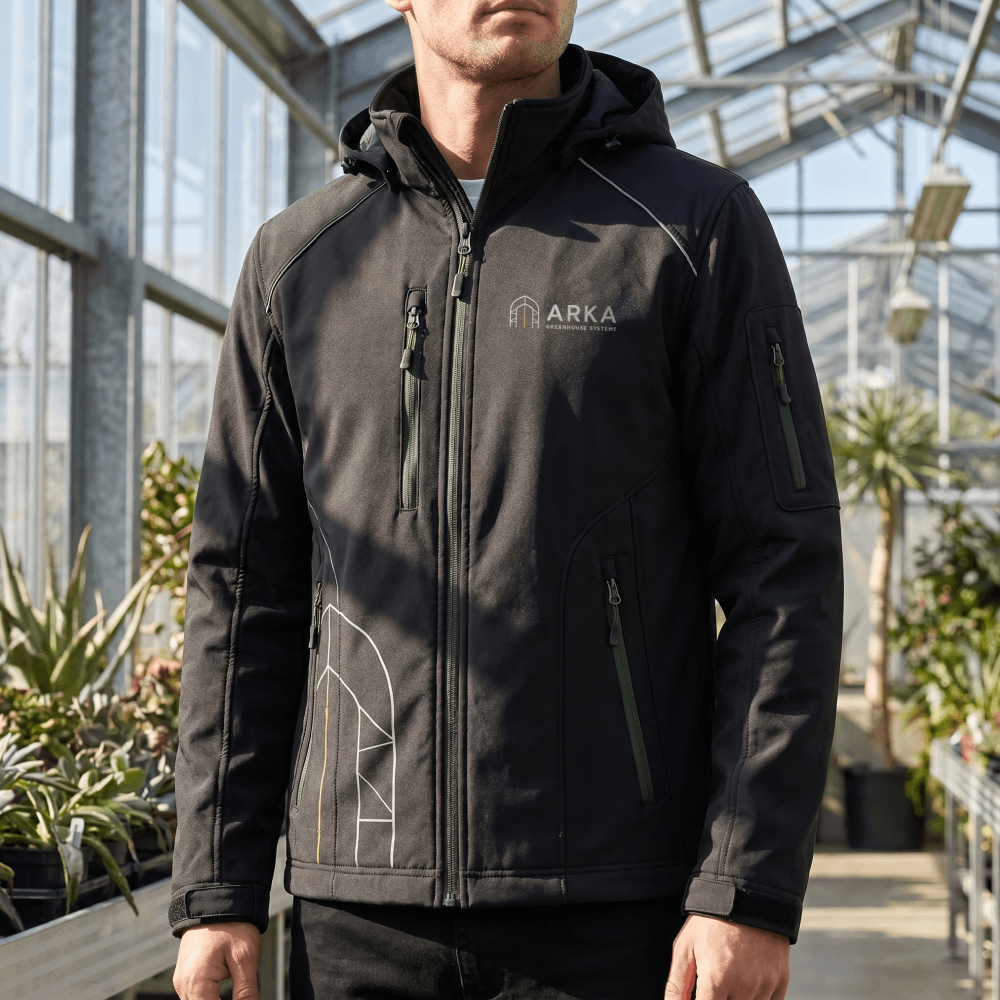
A strong corporate merchandise collection does not require the same logo on every item. A shared logic matters much more: color, material, graphic character, level of detail, and use case. In the ARCA project, this system had to be applied to two fundamentally different products: a soft textile bomber jacket and a business planner.
Below, we examine the production decisions that connected the products and the requirements for preparing a similar project.
The task: create a contemporary corporate product rather than a uniform
The bomber jacket needed to feel like proper clothing that an employee could wear beyond a mandatory event. The planner, in turn, needed to look like an extension of the same visual system while remaining a functional work tool.
Before designing, it is important to separate two tasks:
- emotional: inspire pride and a desire to use the items;
- production: ensure consistency across the run, stable fit, durable branding, and clear quality control.
If the focus is only on an impressive rendering, the actual product may lose its proportions, color, or comfort. If production is the only consideration, the result will be a standard model with a logo. Balance is created at the construction stage.
Two products, one design system
| Element | Bomber jacket | Planner | Shared logic |
|---|---|---|---|
| Primary medium | Knit fabric and lining | Soft-touch cover and paper block | Matte tactile surface |
| Color accent | Lime lining and details | Pantone-colored page edges | Color appears in the construction, not only in the logo |
| Primary mark | 3D Flextran on the chest | UV printing and varnish on the cover | Different technologies, the same visual hierarchy |
| Additional graphics | DTF print on the back | Custom internal sections | An opportunity to communicate more than a single mark |
| Personalization | Sleeves, snaps, labels | Endpapers, ribbons, inner block | The extent of customization depends on budget and quantity |
Bomber jacket construction
The product used brushed three-thread sweatshirt fabric weighing approximately 320-350 g/m². This fabric provides sufficient structure, suits cool weather, and feels considerably heavier than a standard promotional sweatshirt.
The collar, cuffs, and hem are made from rib knit or dense knit fabric. These elements are critical to fit: weak ribbing stretches quickly, while overly stiff ribbing disrupts the proportions. They therefore cannot be chosen solely by the closest color.
A contrasting lime lining is used inside. It is not always visible to others, but creates an effect when unfastened and makes the garment more personal. This approach is more powerful than an additional large logo because it becomes part of the construction.
The bomber jacket fastens with seven soft-touch snaps. The number, spacing, and fastening force of the snaps must be checked on a sample. An overly tight mechanism distorts the front panel, while a loose one looks unreliable. Side pockets are included and also affect thickness, fit, and cost.
Why two branding technologies were used
3D Flextran is placed on the chest. Raised decoration suits a small mark and creates a tactile accent. DTF printing is used on the back, allowing larger and more complex graphics.
This combination addresses two tasks at once:
- the front of the garment stays understated and suitable for everyday wear;
- an expressive communication area appears on the back.
Using the same large-scale technique on the front and back would have been simpler, but visually heavier. In a strong merchandise system, technologies serve different roles.
What can be customized in a similar bomber jacket
- main fabric color;
- lining;
- collar and cuffs;
- snaps and their finish;
- internal and external labels;
- zipper pulls, patches, and insignia patches;
- pocket placement;
- embroidery, DTF, screen printing, or Flextran;
- a personal number or name;
- product packaging.
However, every new detail affects the minimum order quantity and timing. For this level of garment production, the guideline starts at around 50 items, although the exact minimum depends on the fabric, hardware, and production facility.
How to check fit before production
One medium-size sample is not enough. Assess at least several sizes or check the pattern grading. Particular attention is paid to sleeve length, shoulder width, chest volume, pocket placement, and cuff height.
For a unisex model, define the fit in advance: regular, relaxed, oversize, or boxy. The word “loose” is too vague. It is better to agree on reference photos and actual measurements of the finished garment.
The planner as the system's second level
The A5 planner received a hard soft-touch cover. UV printing and varnish are used on it, combining a matte surface with more prominent graphic details.
Inside are 352 pages of offset paper, two ribbon bookmarks, custom internal sections, and endpapers. The page edges are dyed to Pantone, carrying the bomber jacket's lime accent into the printed product without a literal repetition.
The minimum order for this kind of custom planner starts at approximately 100 copies. The more extensively the inner block changes, the more important it is to check in advance:
- section structure;
- calendar data;
- margins and grid;
- typeface legibility;
- Pantone matching;
- page order;
- ribbon placement;
- how well the binding opens.
Why colored edges work better than additional printing
The colored edges are visible when the planner is closed, lying on a desk, or held in the hands. It is a permanent construction accent. Another logo on an inside page would not have had the same effect.
In merchandise, look for areas where brand identity becomes part of the product: lining, page edges, seams, ribbons, zipper pulls, inner labels, and fastenings. These details create the sense of a product developed specifically for the brand.
Preproduction samples and inspection
A project spanning different production categories requires two independent samples and a shared visual review. The colors of fabric, printing, dyed edges, and the digital artwork on screen do not match automatically.
On the bomber jacket sample, check:
- fabric weight and shade;
- fit;
- snap operation;
- pockets;
- branding placement;
- DTF durability and flexibility;
- the height of the 3D Flextran;
- the quality of the lining and internal seams.
On the planner sample, check the cover color, varnish, opening, page-block order, edges, ribbons, and endpapers. The products are then compared side by side to confirm the system's unity.
| The project's key principle is not to make the bomber jacket resemble the planner. Use different materials and technologies while keeping the same character: a matte base, a lime construction accent, and a clear graphic hierarchy. |
|---|
How to adapt the approach to another brand
Define one main construction language
It can be the lining color, contrasting stitching, repeated metal hardware, a pattern, or a distinctive mark shape. The design code must carry across different products.
Separate levels of visual prominence
One item can carry bold graphics and another more subtle ones. Not every item in the collection needs to be equally bold.
Choose materials with a similar character
Matte sweatshirt fabric, soft-touch paper, and muted metal create one atmosphere. A glossy mug, sports polyester, and premium leather can clash even when they are the same color.
Calculate minimum quantities before designing
Garment production starting at 50 units and planners starting at 100 require different quantity planning. Sometimes it is more practical to make 100 planners and 50 bomber jackets, allocating the remaining stationery to other events.
Prepare a system rather than a single artwork file
Rules are needed for using color, graphics, the logo, and details. A tote bag, bottle, fabric key tag, or packaging can then be added to the bomber jacket and planner without starting over from scratch.
FAQ
How does a corporate bomber jacket differ from a ready-made jacket with a logo?
A custom bomber jacket allows changes to fabric, fit, lining, hardware, pockets, and labels. A ready-made model is faster and more affordable, but limits structural customization.
Why were different technologies chosen for the chest and back?
A small 3D Flextran element creates neat relief on the front, while DTF suits larger, more complex graphics on the back. This maintains a balance between everyday wearability and expressiveness.
Can DTF be replaced with embroidery?
Yes, if the design and fabric are suitable. Large, dense embroidery adds weight and stiffness to the back, so its size and stitch count must be checked on a sample.
How do you choose the exact fabric color?
Using physical samples, rather than only Pantone on a screen. Stock fabrics have a limited palette, while dyeing to Pantone requires a separate minimum order quantity.
Why create a custom planner block?
It turns standard stationery into a working tool for the company. Inside, you can include values, project structures, checklists, an events calendar, or special sections.
Can each individual item be personalized?
Yes. Names, numbers, or individual patches are possible for the bomber jacket. For the planner: a name on the cover or insert. This affects file preparation and completeness checks.
How long does this kind of project take?
Timing depends on fabric and hardware availability, the number of samples, the extent of customization, and production workload. Plan the project backward from the handover date, allowing time for revisions.
Discuss your project
If your company needs a cohesive merchandise system rather than standard apparel with a logo, send Impulse Media the task, audience, quantity, date, and visual constraints. We will develop the collection's construction language, select materials, prepare visualizations, and arrange samples before production begins.