Short answer
Corporate merchandise by itself is not a proven way to reduce employee turnover. An employee rarely stays at a company solely because of a hoodie, insulated mug, or gift set.
However, a physical product can be part of a system of recognition, onboarding, and belonging. Research confirms an association between high-quality recognition, a positive employee experience, and a greater likelihood of staying with the company.
In a longitudinal study by Gallup and Workhuman the career paths of nearly 3,500 employees were tracked from 2022 to 2024. Workers who received high-quality recognition were 45% less likely to change organizations over the following two years. The study assessed the entire recognition system, rather than the effect of gifts or merchandise as a standalone tool.
SHRM's The Case for Employee Experience, a study involving 2 403 respondents, found that employees with a positive employee experience were 68% less likely to consider leaving. Among employees in a negative culture, 42% considered leaving, compared with 9% among those in a positive culture. The data relates to the US labor market.
What the chart shows
| Employee group | Illustrative departure-risk index |
|---|---|
| Low-quality recognition | 100 |
| High-quality recognition | 55 |
Data source: Gallup and Workhuman, 2024. Chart methodology: the value of 55 was calculated as an editorial index based on a 45% reduction in the likelihood of leaving. This is not the absolute proportion of employees who left.
Where merchandise plays a role
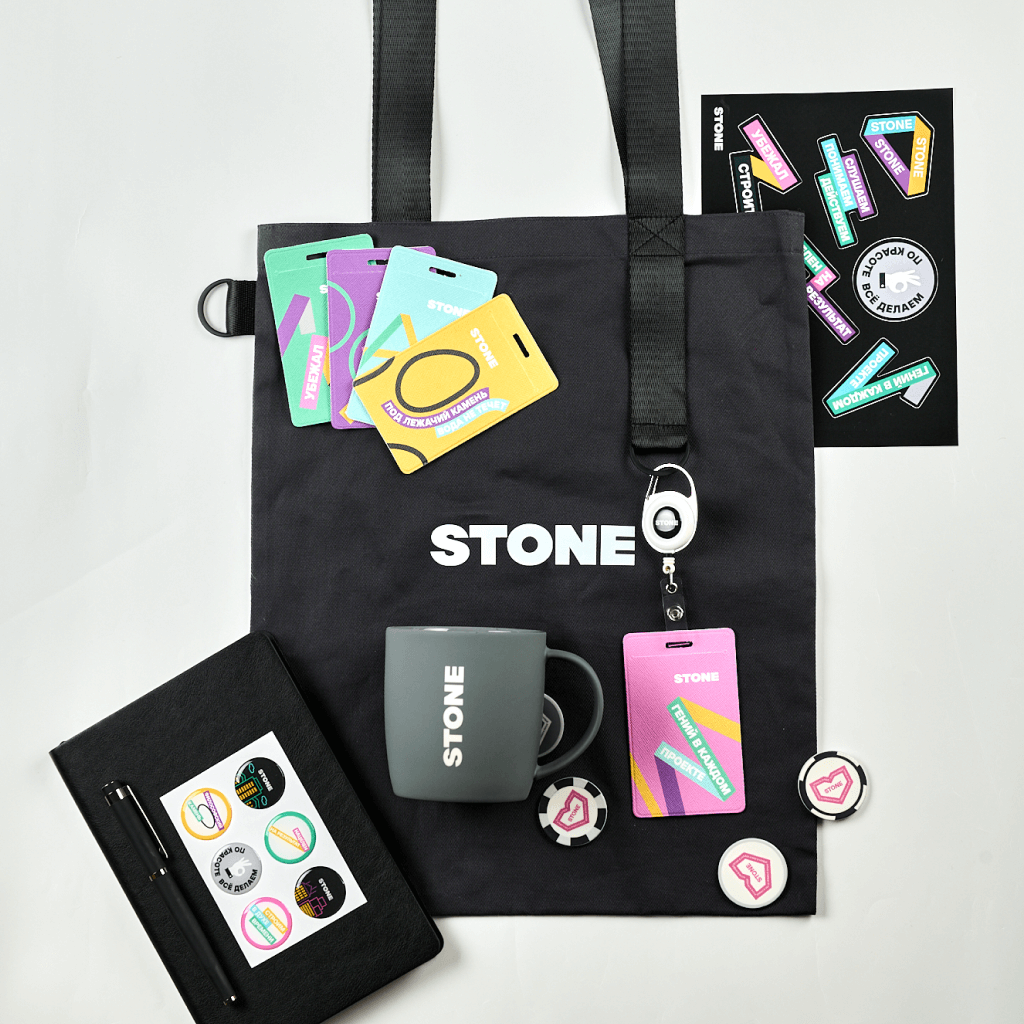
Merch works as a physical expression of an event, rather than as a standalone benefit.
For example:
- welcome pack marks the start of employment;
- corporate apparel helps express belonging to the team;
- awards preserves the story of the achievement;
- custom-made merchandise allows the item to be linked to a specific project or career stage;
- a personalized product shows that the company has noticed a specific individual.
Research by O.C. Tanner on symbolic awards shows that employees were three times as likely to remember a recognition experience when it was accompanied by a symbolic award. They were also 358% more likely to be able to describe the event in detail. High-quality items connected to the culture and a real achievement had the greatest effect.
What merchandise cannot fix
| Cause of dissatisfaction | Can merchandise solve the problem |
|---|---|
| Uncompetitive pay | No |
| Chronic overload | No |
| Unfair management | No |
| Lack of development | No |
| Poor communication | No |
| Lack of recognition | Partly |
| A weak sense of belonging | Partly |
| Lack of shared rituals | Partly |
| Important events left unmarked | Yes, as a physical symbol |
That is why the promise that “merchandise reduces employee turnover” is methodologically unsound. A more accurate formulation:
A quality corporate product helps make recognition visible, personal, and memorable.
When the program works better
The item is connected to a specific contribution
Instead of an impersonal “thank you for your work,” the employee should understand:
- what they are being recognized for;
- what result they achieved;
- why the result matters;
- which company value they embody.
Choice is available
An internal store can offer employees a choice of:
- Color;
- size;
- a product category;
- personalization;
- delivery;
- an alternative to a physical gift.
For this kind of catalog, you can use Impulse Media’s existing product range: clothing, electronics, gift sets and home goods. The catalog lets you build several award tiers rather than limiting the program to the same souvenir.
The program covers different stages
| Event | Possible format |
|---|---|
| First day | Welcome pack |
| Completion of the probationary period | A personal letter and a small item |
| Successful project | Team merchandise |
| Certification | Chevron patch, badge, or points |
| 1, 3, 5, 10 years | Milestone award |
| Helping colleagues | Peer-to-peer recognition |
| Internal conference | Limited collection |
How to measure the outcome
| Metric | What it shows |
|---|---|
| Program coverage | How many employees participate |
| Redemption rate | Are points being used |
| Share of recognition from managers | Does management support the program |
| Peer-to-peer recognition | Does a horizontal culture work |
| eNPS | Willingness to recommend the employer |
| Intention to stay | Early indicator of departure risk |
| Participant turnover | Long-term outcome |
| Product use | Usefulness of merchandise |
| Time to recognition | How quickly contributions are noticed |
Employee turnover cannot be compared only before and after the launch of a gift program. Pay, the labor market, management changes, career opportunities, and workload all affect the outcome at the same time.
Related articles
- Corporate apparel with a logo
- Gift sets and welcome packs
- Awards
- Custom merchandise
- The full Impulse Media catalog
Photo and source
Colleagues working and discussing a project in an office — Pexels
Photo: Thirdman / Pexels. Used under the Pexels license. The image is illustrative.